“Should we choose State Board or CBSE?” is one of the most common questions Karnataka parents ask, and one of the most heavily opinionated. Friends, relatives and online forums will often give you a confident answer. This guide takes a more even-handed route: what actually differs between the two, what does not, and how to decide for your child.
The short version
Both boards teach the full range of school subjects, and children from either can go on to the same colleges, courses and careers. The differences lie mostly in syllabus, exam pattern, language arrangements and what happens if you move. Neither is “better” in general. One may simply suit your family’s circumstances more than the other.
What each board is
Karnataka State Board schools follow the state syllabus. Children sit the SSLC examination at the end of Grade 10, and then usually move into PU College (Pre-University, Grades 11 and 12).
CBSE (Central Board of Secondary Education) is a national board. Its schools follow a national curriculum framework, with board examinations at the end of Grade 10 and Grade 12.
How they compare in practice
Syllabus and style
CBSE schools commonly use the NCERT textbooks, which are used across India. State Board schools use state-prescribed textbooks. The subjects overlap heavily, but the sequence, depth and emphasis can differ from topic to topic. If your family expects to relocate within India, the national curriculum can make a move between cities simpler.
Exams along the way
State Board students face the SSLC at Grade 10 and the PU board exam at the end of Grade 12. CBSE students face a board exam at both Grade 10 and Grade 12 under the same board. Ask any school you visit how it prepares children for these exams, and how regular internal tests and assessments are built into the year.
Language
Karnataka expects Kannada to be taught in schools across boards. What varies is how the school arranges it, and which languages are offered alongside English. If your child has never studied Kannada, ask how a school supports learners who are starting from scratch.
Competitive entrance exams
Students from both boards sit national entrance exams such as NEET and JEE. CBSE’s NCERT-based syllabus is closely aligned with the way these exams are set, which is one reason many families choose it. That said, students from State Board schools also take and clear these exams, and the quality of teaching and a child’s own effort count for more than the board’s name. Ask every school how its older students are guided on this.
If you move
A child who changes city mid-school is often easiest to place within the same board. If a job transfer is a real possibility for your family, the national board may offer more continuity. If you expect to stay in Karnataka, this point matters much less.
What matters more than the board
Parents sometimes spend months on the board question and a few minutes on the things that shape a child’s day. In practice these usually matter more:
- The teachers. Experienced, stable, caring teachers make any syllabus work.
- Class size and attention. Does each child get noticed?
- Continuity. Can your child stay on one campus from the early years to the board exams, instead of changing schools at a stressful moment?
- Medium of instruction. Is the school English-medium, and how strong is the language support?
- Beyond the textbook. Sports, Abacus and Vedic Maths, Olympiad preparation, Scouts and Guides and the arts all shape confidence.
- The commute. A long daily journey costs a young child more than most syllabus differences ever will.
Questions to ask yourself first
- Will we likely stay in Karnataka through Grade 10 and beyond, or might we relocate?
- Is my child comfortable with Kannada, or do we need strong language support?
- What do we imagine after school? If a particular national entrance exam is a firm goal, ask schools how they support it.
- How does my child learn best? Some children thrive on structured, exam-oriented routines; others need more activity and encouragement.
- Can we get to school easily every day?
Questions to ask each school
- Which board do you follow, and for which grades?
- What are your board exam results over the last few years, including distinctions, shown in writing?
- How are children prepared for board exams, and when does that preparation begin?
- How does the school handle Kannada and other languages?
- Can my child stay on this campus through to the board exams?
Where St. Lawrence stands
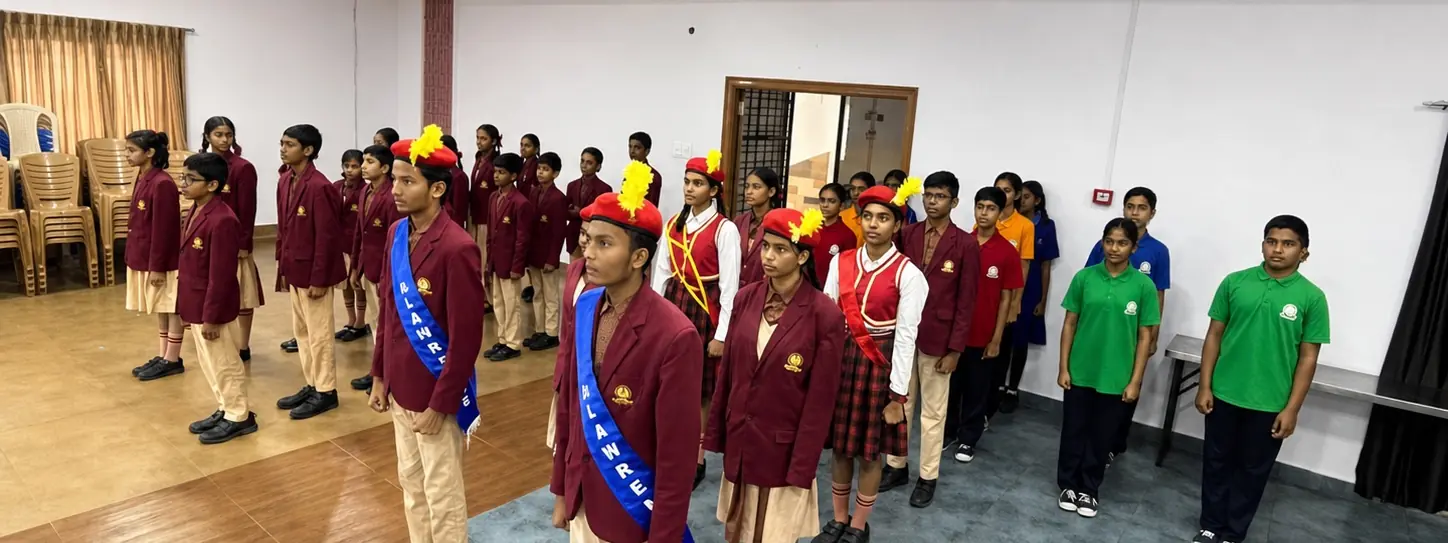
St. Lawrence High School & PU College is an English-medium State Board school in Kamakshipalya, on Magadi Main Road. It has a 100% SSLC pass record and takes children from the Nursery Wing through the Primary Wing and High School, with PU College on the same campus. Enrichment such as Abacus and Vedic Maths, karate, Scouts and Guides and Olympiad preparation runs alongside the syllabus.
For families who prefer a CBSE curriculum, our management is also opening Birla Open Minds International School at Kadabagere Cross, with admissions for 2027–2028 opening shortly. Our admissions team is happy to explain how the two differ so you can choose the one that fits your child, and not simply the one that is closest.
You can read more about each wing on our academics page, or see the admission process for the steps, documents and age criteria.